NOTES / AGENTIC DESIGN PATTERNS
Choosing a pattern
A decision guide that ties the patterns together: match the shape of the task to the simplest pattern, and move up only when evals say you must.
The rule
Anthropic’s advice is to find the simplest solution that works and add complexity only when needed, which can mean not building an agentic system at all1. OpenAI’s orchestration advice has the same shape for agent count: start with a single agent and move to several when necessary2. This note turns that rule into a lookup.
Match the task to the pattern
Anthropic describes five workflow patterns plus the autonomous agent1. Each solves a particular shape of problem.
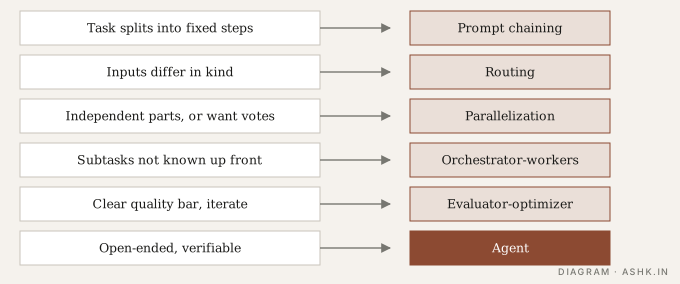
Diagram: my own mapping, built from the pattern descriptions in 1.
| Pattern | Use when | Costs you |
|---|---|---|
| Prompt chaining | the task splits cleanly into fixed steps; trade latency for accuracy by making each call easier1 | latency |
| Routing | different kinds of input need different handling, so one prompt would be hurt by another’s tuning1 | a classifier step |
| Parallelization | parts are independent, or you want several attempts to vote1 | more calls at once |
| Orchestrator-workers | you cannot predict the subtasks in advance1 | coordination, tokens |
| Evaluator-optimizer | you have clear criteria and iteration measurably helps1 | extra rounds |
| Agent | the path is open-ended and you can verify progress1 | latency, cost, risk |
Details of the five workflows are in Workflows vs agents. Related notes: Reflection for the evaluator-optimizer loop, Multi-agent systems for orchestrator-workers and handoffs.
Climb the ladder only when forced
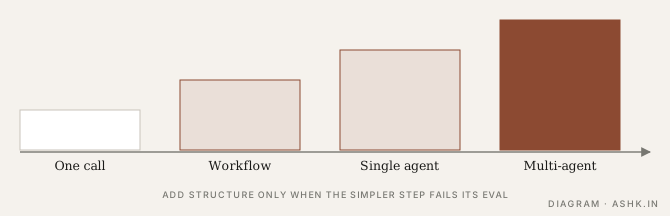
Diagram: my own and illustrative; the heights show ordering, not measurements.
Each rung adds cost. Anthropic’s measurements make the top rung concrete: agents use about four times the tokens of chat, and multi-agent systems about fifteen times3. Those figures come from their Research system and will differ for yours.
The practical procedure:
- Write the eval first. Without a way to tell better from worse, you cannot justify more structure (Why evals).
- Build the simplest version and measure it.
- Read the failures. Which kind is it: wrong steps, missing knowledge, bad tool choice, low-quality output?
- Add the smallest pattern that targets that failure. Wrong order of steps suggests a chain or plan. Mixed input types suggest routing. Weak drafts suggest a critic. Context overflow suggests delegation.
- Re-run the eval, and keep the change only if it moved the number enough to pay for itself.
Combine, do not worship
Patterns are building blocks, not exclusive choices. A routing step in front of specialised chains, an agent inside one branch, a critic on the final draft, and a human approval gate before an irreversible action are all normal in one system. Anthropic frames them as composable patterns you can combine and customise1.
Questions to settle up front
- What does “done” look like, and can it be checked? (Stopping conditions)
- How much freedom is safe? (Levels of autonomy)
- What happens when a tool fails? (Error handling and recovery)
- Is an agent even the right tool? (When not to use an agent)
Sources
- [1]Building effective agents — Erik Schluntz and Barry Zhang · Anthropic · 2024PARAPHRASED
- [2]A practical guide to building agents — OpenAI · 2025PARAPHRASED
- [3]How we built our multi-agent research system — Anthropic Engineering · 2025PARAPHRASED