NOTES / AGENTIC DESIGN PATTERNS
Multi-agent systems
When several agents beat one, when they do not, and the two main shapes: orchestrator-worker and handoff. With the evidence for and against.
Start with one agent
OpenAI’s guidance is to begin with a single agent and move to several only when needed5. A single agent with tools in a loop already covers a lot. The case for more than one has to be earned by a limit you have actually hit, such as a context window that overflows, tools so numerous that selection suffers, or work that is truly parallel.
The evidence for
Anthropic’s Research feature is the best-documented example. It is an orchestrator-worker system: a lead agent plans a research process, then creates subagents that search in parallel1. On their internal research eval, a system with Claude Opus 4 as lead and Claude Sonnet 4 subagents beat a single-agent Claude Opus 4 by 90.2%1. The gains were strongest on breadth-first queries with several independent directions1.
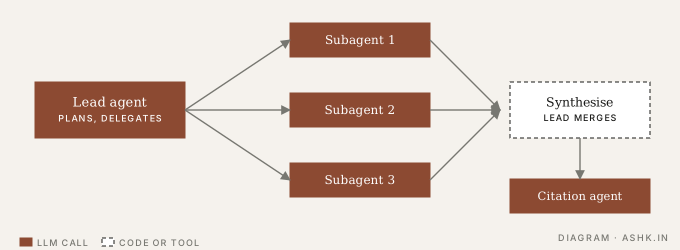
Diagram: my own, following the orchestrator-worker structure in 1.
Why it worked is instructive. Anthropic found that token usage alone explained 80% of the variance in a browsing evaluation, with tool calls and model choice as the other factors1. Multiple agents are one way to spend more tokens, each in its own context window, on a task that exceeds one agent’s limit1.
The cost
That token spend is the price. In Anthropic’s data, agents typically use about 4× more tokens than chat, and multi-agent systems about 15× more1. They also note that coordination complexity grows quickly1. So the pattern fits tasks valuable enough to pay for it and wide enough to parallelise.
The evidence against
Cognition argued in 2025 that most people should not build multi-agent systems. Their two principles: share context fully, meaning whole agent traces and not just messages; and remember that actions carry implicit decisions, so conflicting decisions produce bad results2. When work is split, sub-agents lack the upstream context and decisions get dispersed2.
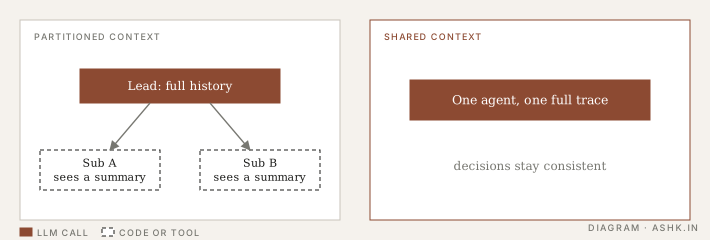
Diagram: my own, illustrating the trade-off argued in 2.
Independent research points the same direction on reliability. A UC Berkeley team studying multi-agent LLM systems reports that their gains on popular benchmarks are often minimal, and built MAST, a failure taxonomy based on annotated traces4. Its categories include premature termination, incomplete or incorrect verification, task derailment and ignoring other agents’ input4.
Cognition revisited the question in April 2026. Their position is that a narrower class now works, where agents contribute intelligence while writes stay single-threaded3. One example is a code-review loop that worked best when the coding and review agents did not share context beforehand3. Note how that agrees with the evidence above: the reviewers add independent judgement, and a single agent still writes.
Two shapes
OpenAI names two orchestration patterns for multiple agents5.
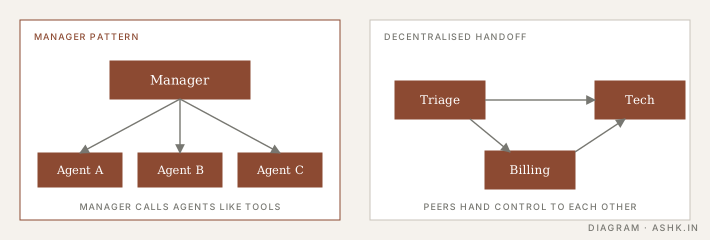
Diagram: my own, after the two patterns described in 5.
- Manager: a central agent calls specialist agents as if they were tools, and keeps control of the conversation.
- Decentralised handoff: peers pass control to each other, so the receiving agent takes over the interaction.
Anthropic’s orchestrator-worker is the manager shape, with workers running in parallel1. Handoff suits triage-style systems where a specialist should own the rest of the exchange.
A checklist before you split
- Does the task decompose into independent parts? If the parts constantly need each other’s context, keep one agent.
- Is it worth roughly an order of magnitude more tokens?
- Can you verify each sub-result before merging?
- Who is the single writer of the final state?
- Can you trace every agent so a failure can be localised?
Mechanics of delegation inside one product are in Subagents, and cross-vendor messaging in A2A. Choosing a pattern ties this to the other options.
Sources
- [1]How we built our multi-agent research system — Anthropic Engineering · 2025PARAPHRASED
- [2]Don't Build Multi-Agents — Walden Yan · Cognition · 2025PARAPHRASED
- [3]Multi-Agents: What's Actually Working — Walden Yan · Cognition · 2026PARAPHRASED
- [4]Why Do Multi-Agent LLM Systems Fail? — Mert Cemri and co-authors · arXiv · 2025PARAPHRASED
- [5]A practical guide to building agents — OpenAI · 2025PARAPHRASED