Clinical NLP
How clinical text becomes structured data: sections, entities, assertion status such as negation, concept normalisation, and where LLMs fit and fail, including summary error types.
Concepts only. Not medical advice.
The job
Much of a patient’s record is free text. Clinical NLP turns it into something a program can use: a problem list, a medication table, a cohort for research.
A classic pipeline
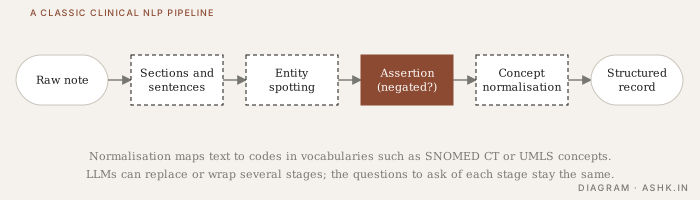 Diagram: my own sketch of the usual stages.
Open-source systems such as Apache cTAKES follow this shape: split text into sections and sentences, find clinical entities, then link them to codes in standard vocabularies.1 The assertion step is the one people forget, and it matters most.
Assertion: same word, different meaning
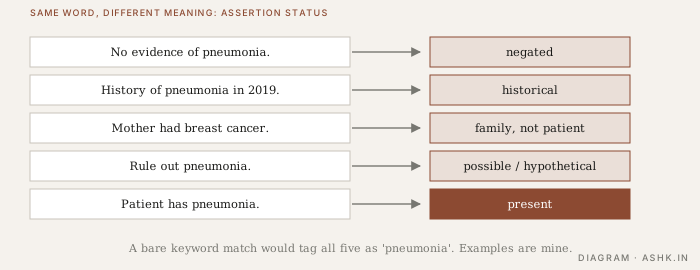 Diagram: my own examples.
Clinical notes are full of negation, history and hedging. NegEx, an early and influential approach, used simple trigger phrases and scope rules to decide whether a finding was negated.2 Modern systems also tag whether a mention is historical, hypothetical or about a family member. A keyword search that ignores these will count “no evidence of pneumonia” as pneumonia.
Where LLMs fit
An LLM can do extraction and normalisation in one prompt, often with structured outputs. That is convenient, but it moves the risk: you now need to check assertion, dates and codes on a labelled sample, as in building eval sets.
Summaries and their error types
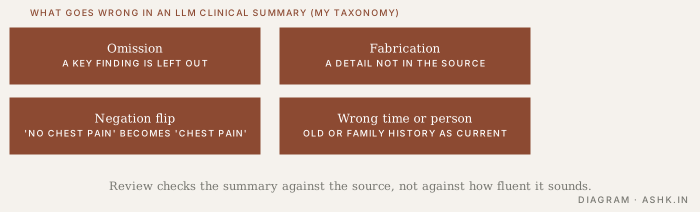 Diagram: my own taxonomy, not a published standard.
Fluent summaries hide errors well. I group them as omission, fabrication, negation flips and wrong time or person. Physician-rated evaluations of medical LLMs use multi-axis rubrics for this reason, since accuracy alone misses omissions and harm.3 Pair any summariser with review against the source and with a judge you have validated. Privacy comes first, though: see privacy and regulation before sending any note to a model.
Sources
- [1]Apache cTAKES, clinical Text Analysis and Knowledge Extraction System — Apache Software Foundation · 2026PARAPHRASED
- [2]A simple algorithm for identifying negated findings and diseases in discharge summaries — Chapman et al. · 2001PARAPHRASED
- [3]Toward expert-level medical question answering with large language models — Singhal et al. · 2025PARAPHRASED