Privacy and regulation
HIPAA de-identification routes, GDPR's two-layer rule for health data, the EU AI Act in outline, and what to ask before sending clinical text to any model. Concepts only, not legal advice.
I am not a lawyer. This is a conceptual map, not legal advice. Laws differ by country and change; check current texts and ask counsel.
HIPAA de-identification (US)
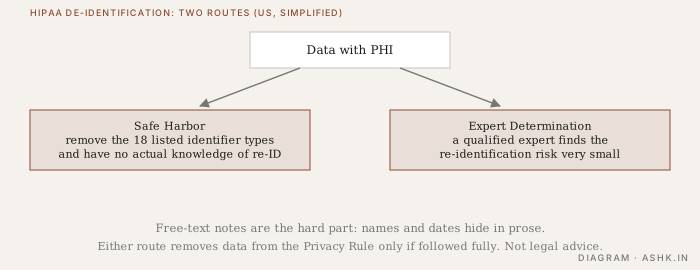 Diagram: my simplified summary.
HHS guidance describes two routes under the Privacy Rule: Expert Determination, where a qualified expert concludes that re-identification risk is very small, and Safe Harbor, which removes a list of 18 identifier types and requires that the entity has no actual knowledge that what remains could identify someone.1 Data de-identified this way is no longer protected health information, but only if the method is followed fully. Free text is the hard part for NLP: identifiers hide inside prose, and the HHS FAQ addresses free-text fields.1 HIPAA is also narrower than people assume; it applies to covered entities and their business associates.
GDPR (EU and UK)
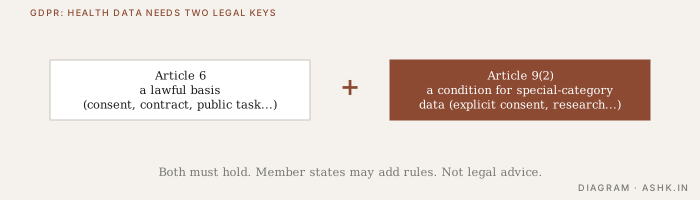 Diagram: my own summary.
Health data is special category data. The UK regulator explains you need both a lawful basis under Article 6 and a separate condition under Article 9.2 Explicit consent is one Article 9 condition; research and public-health conditions exist too, with member-state rules on top. Solely automated decisions with significant effects face further limits.2
EU AI Act in outline
The EU AI Act sorts systems by risk and puts duties on high-risk ones; medical-device software can fall in that group.3 Application dates are phased and have been subject to proposals for delay, so check the current timetable instead of trusting a date in a blog post.
WHO framing
WHO guidance on large multimodal models adds ethics and governance recommendations for governments, developers and providers.4
Before you send clinical text to a model
- Is the data identifiable, and under which law?
- Does the provider contract cover health data and forbid training on your inputs?
- Where is it processed and stored, and who can see logs?
- Can you minimise first, for example by redacting identifiers?
See also sandboxing, input and output guardrails and clinical NLP.
Sources
- [1]Guidance regarding methods for de-identification of protected health information in accordance with the HIPAA Privacy Rule — US HHS Office for Civil Rights · 2012PARAPHRASED
- [2]What are the rules on special category data? — UK Information Commissioner's Office · 2025PARAPHRASED
- [3]The EU Artificial Intelligence Act — Future of Life Institute (unofficial portal) · 2026PARAPHRASED
- [4]Ethics and governance of artificial intelligence for health: guidance on large multi-modal models — World Health Organization · 2024PARAPHRASED