Validation and safety in medicine
The validation ladder from internal tests to trials and monitoring, why external validation matters (with the Epic sepsis model as a cautionary case), and why site shift happens.
Concepts only. Not medical advice.
The ladder
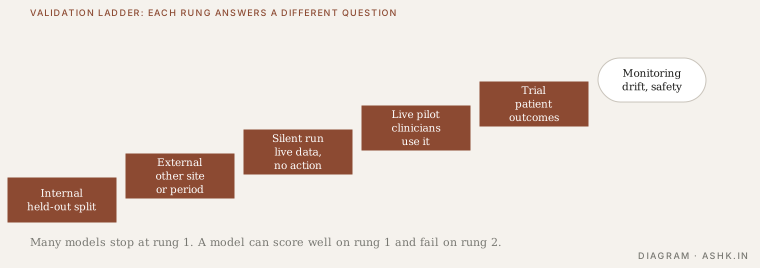 Diagram: my own framing; each rung answers a different question.
- Internal: a held-out split from the development data. TRIPOD+AI asks authors to report how this was done.2
- External: data from another hospital or period.
- Silent run: the model runs on live data but nobody acts on it.
- Live pilot: clinicians use it; DECIDE-AI covers reporting here.3
- Trial: patient outcomes, reported under standards such as CONSORT-AI.4
- Monitoring: drift and safety after launch, as in online evals.
A cautionary case
A widely deployed proprietary sepsis prediction model was externally validated at one academic centre by Wong and colleagues, who reported performance well below what the vendor had described, including missed cases and many alerts.1 Check the paper for exact figures. The lesson is general: a model that works where it was built can disappoint elsewhere, and vendor numbers are not a substitute for local testing.
Why site shift happens
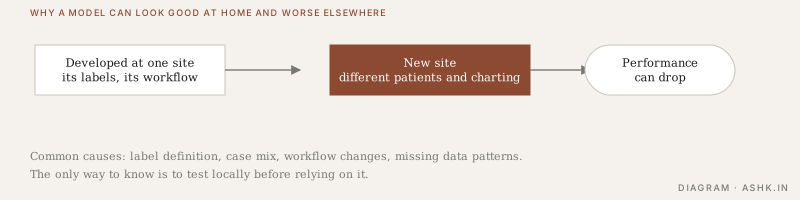 Diagram: my own sketch of common causes.
Label definitions, patient mix, charting habits and missing-data patterns differ between sites. A sepsis label built from billing codes at one hospital is not the same as one built from clinician judgement at another. The same idea appears in split leakage for training data.
Safety practice
Define who owns an alert, how failures are reported, when the tool is switched off, and how performance is rechecked. Use tracing and monitoring for LLM tools and keep a human in the loop for consequential actions.3
Sources
- [1]External validation of a widely implemented proprietary sepsis prediction model in hospitalized patients — Wong et al. · 2021PARAPHRASED
- [2]TRIPOD+AI statement: updated guidance for reporting clinical prediction models that use regression or machine learning methods — Collins et al. · 2024PARAPHRASED
- [3]Reporting guideline for the early-stage clinical evaluation of decision support systems driven by AI: DECIDE-AI — Vasey et al. · 2022PARAPHRASED
- [4]Reporting guidelines for clinical trial reports for interventions involving artificial intelligence: the CONSORT-AI extension — Liu et al. · 2020PARAPHRASED