The healthcare AI landscape
Where AI is used in healthcare, how fast-moving the regulated-device picture is, what the WHO says about large multimodal models, and why medicine raises the bar on everything else in these notes.
These notes explain concepts. They are not medical, legal or regulatory advice.
Why a healthcare section
Every earlier section of these notes (retrieval, agents, evals, guardrails) applies here, but the cost of a wrong answer is higher and the rules are stricter. Healthcare is a good stress test: if a practice survives here, it is usually sound elsewhere.
Where AI is used
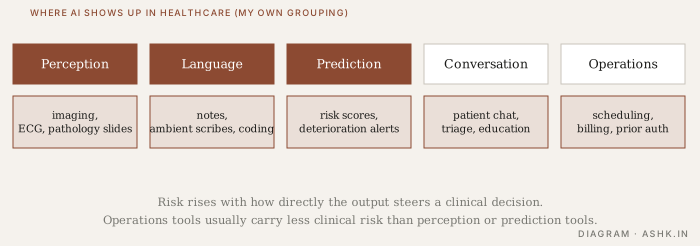 Diagram: my own grouping of five areas, from perception to operations.
- Perception: models that read images, signals or slides. This is the oldest and most heavily regulated area. The US FDA publishes a list of AI-enabled devices it has authorised, and the count keeps growing, so check the current list rather than a number quoted in an article.1
- Language: clinical notes, summaries, coding and ambient documentation. See clinical NLP.
- Prediction: risk scores and alerts. See validation and safety.
- Conversation: patient-facing chat and triage.
- Operations: scheduling, billing, prior authorisation. Usually lower clinical risk, though privacy rules still apply.
My own rule of thumb: the more directly an output steers a clinical decision, the more evidence and oversight it needs.
What the WHO says about large multimodal models
In January 2024 the WHO issued guidance on large multimodal models for health.2 As summarised in its release, it names five broad applications: diagnosis and clinical care, patient-guided use, clerical and administrative tasks, education, and scientific research. It also lists risks such as false, biased or incomplete statements, and sets out more than 40 recommendations for governments, developers and providers.2 Treat it as a policy framing, not a technical standard.
Benchmarks are not deployment
Medical question-answering results are striking: Med-PaLM 2 was reported at up to 86.5% on MedQA, and physicians preferred its long-form answers to physician answers on most axes in one study. Its authors also stress that real-world validation is still needed.3 A quiz score tells you about knowledge recall, not about safety inside a hospital workflow. This is the same lesson as in benchmarks, with higher stakes.
From model score to patient benefit
The DECIDE-AI authors describe a gap: many decision-support systems look promising in offline evaluation, but few have shown real benefit to patient care.4 Most clinical AI is decision support, a tool used alongside people, so the human interaction is part of what you are evaluating. The next notes cover how: evidence appraisal, clinical decision support, validation and privacy and regulation. For the general safety toolkit, see the threat model and human approval.
Sources
- [1]Artificial Intelligence-Enabled Medical Devices — US FDA · 2026PARAPHRASED
- [2]Ethics and governance of artificial intelligence for health: guidance on large multi-modal models — World Health Organization · 2024PARAPHRASED
- [3]Toward expert-level medical question answering with large language models — Singhal et al. · 2025PARAPHRASED
- [4]Reporting guideline for the early-stage clinical evaluation of decision support systems driven by AI: DECIDE-AI — Vasey et al. · 2022PARAPHRASED